Find out if it can work.
Proof of Concept / Europe
Find out whether the ambitious part of your idea can actually work, before committing to the whole product.
01From the idea to the experience

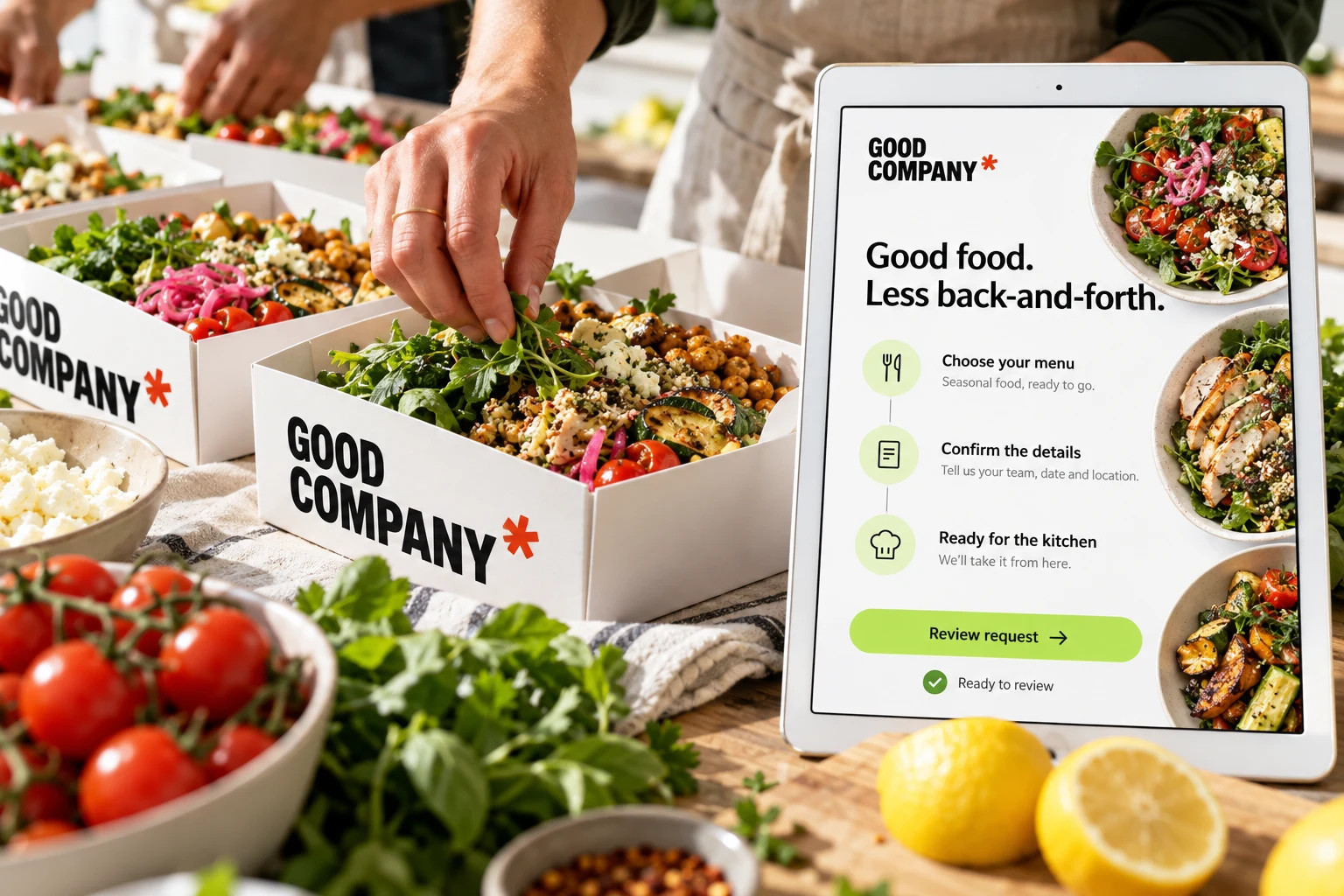
For GOOD COMPANY, the uncertainty is behind the screen: whether a request can reach the existing workflow with the right information.
A good idea needs to work behind the scenes.
For a business like this fictional food service, the question might be whether customer requests can reach the team's existing system reliably. We isolate the uncertain part and test it with working code.
- 01Name the difficult question
- 02Build a focused experiment
- 03Decide with better evidence
Illustrative, AI-generated direction, not a delivered client project. Your project would have its own audience, identity and agreed scope.
What you get
A working demonstration of an agreed technical hypothesis, feasibility findings and a risk map.
Why it matters
Discover what is feasible, what is risky and what needs to change before a larger commitment.
What comes next
A technical experiment is not a launch-ready product. Production engineering is scoped separately.
See the sample technical experiment
Proof of Concept sample deliverable
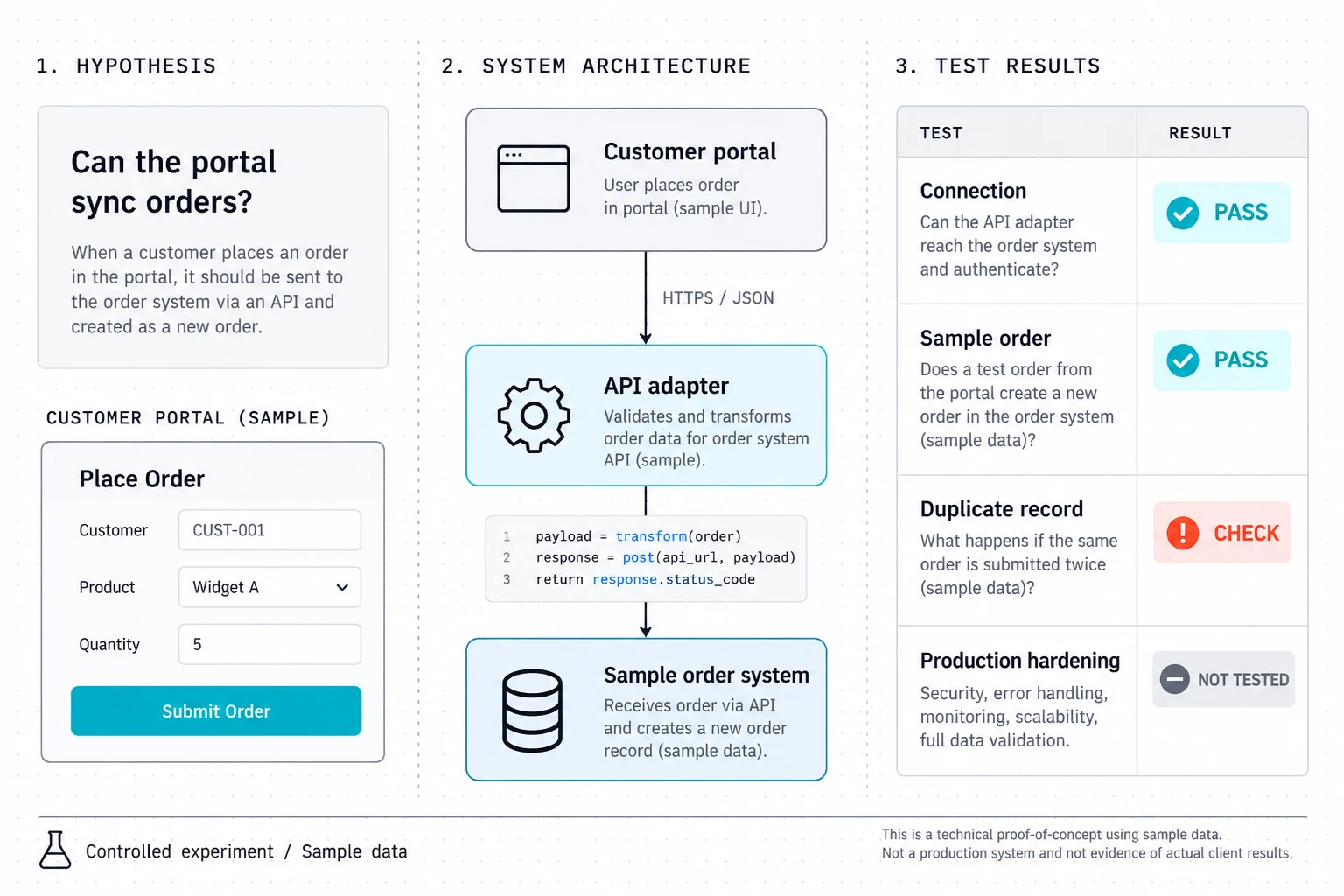
Working code to answer one difficult question.
- 01Define the hypothesis
- 02Engineer the experiment
- 03Document evidence and risks
What you get
A working demonstration of an agreed technical hypothesis, feasibility findings and a risk map.
What it answers
Can the uncertain integration, rule or technical approach work under defined conditions?
What it is not
A successful experiment does not establish production security, reliability or scalability.
Read the image description
Illustrative feasibility experiment: a customer portal connects to an API adapter and sample order system; a findings sheet separates passing checks from unresolved risks. Working code to answer one difficult question. The image is an illustrative, AI-generated artifact. Its labels and sample findings are not evidence from a client project. The service scope is defined by the text above and the agreed proposal.
02Your next step
Is this your next step?
Business owners whose idea depends on something uncertain, such as connecting existing systems, automating a process or handling complex rules.
What you take away
- 01Technical feasibility
- 02Prototype engineering
- 03Risk map
- 04Working demonstration
Scope and limitations
The question we solve
Some questions need working code. A proof of concept isolates the uncertain part of a product and tests whether the proposed approach is viable. We define what needs to be demonstrated, which constraints matter and what evidence will help you decide whether to proceed.
Your deliverables
You receive a working demonstration of the agreed technical hypothesis, feasibility findings and a risk map. The result helps shape the next engineering decision. Security hardening, operational reliability and full-scale delivery need their own scope.
Indicative starting budgets in EUR. These figures are planning estimates, not binding offers. No payments are collected through this site.
Selected. Not sold.
Human-led. English-first. AI-assisted written translation, not fluency in every language. No video calls. This application is a non-submitting preview.
Submit
Share your idea, constraints and ambition. Applying is the first step; no payment is required.
Review
We assess fit, complexity and timing. We accept projects where we can make a meaningful contribution.
Scope
If there is a fit, we define scope, deliverables and timing. Contracting and billing arrangements must be confirmed before any paid engagement.
Build
Build starts only after scope, the contracting party and applicable billing arrangements are confirmed.